

Our Story
What We Believe Makes Us Different
Tom Villalta has navigated financial markets for more than 25 years. Starting as a career investment analyst and portfolio and risk manager, Villalta later focused on multi-billion-dollar institutional investors along with ultra-high wealth individuals and families. His mix of academic and hands on experience mean Villalta offers clients a micro and macro view of the changing economy and markets. In short, clients of all types and sizes can benefit from his cutting-edge research and investment advice.
Founding Austin | 180 has allowed Tom to create the kind of financial management firm he always envisioned would serve clients best. He spends significant time assessing each client’s investment needs and helping them to identify long-term goals. His research and advice regarding domestic and global markets not only help investors grow wealth but also help clients determine risks and opportunities for their business interests and other areas of investment.
No hidden fees or incentives, no one size fits all plans. Just independent, transparent, and enterprising investment advice with attention to personal service. Today, high-net-worth clients trust Tom to guide them through an increasingly complex and precarious investment world and to find unique investment opportunities even in the worst of economic times.

Our Investment Philosophy
We don’t take a cookie-cutter approach to building client portfolios. First, we determine what the client’s underlying needs are and then we tailor a bespoke solution to the client’s specific needs. This means balancing the financial risk some portfolio elements may pose to the client’s life (like an overly concentrated position in the energy sector for example) or, building a constraint free portfolio that offers a wider array of opportunities (for example: a retiree who entrusts us with investing the bulk of their asset base.) In short, your financial needs and goals always come first.
From there, our eyes remain adamantly focused on fulfilling your financial expectations with the least amount of risk necessary. Austin | 180 Advisory Group believes there are no easy solutions and no magic formulas for managing investment portfolios. There is no substitute for financial experience and education. We may take tactical positions and have views on the state of the market and economy, but we are in no way “market timers”. We don’t believe one should view their investments with an eye towards entering and exiting markets with any sort of precision.
We also don’t believe markets have binary solutions (you’re either in or you’re out.) Rather, we look for trade-offs and to position your investments in an effort to avoid bad outcomes and insulate investment portfolios from risk.
Our in-depth analysis starts with aligning your assets into three specific groups:
- Economically Sensitive Assets
- Interest Rate Sensitive Assets
- Idiosyncratic Assets
These groups are not entirely straightforward and may include assets investors don’t typically consider. Our approach does NOT rely on a more simple, traditional view of stocks, bonds and alternatives. Rather, we determine what shapes extreme negative outcomes and use that as our basis for creating a diversified and risk-averse portfolio that maintains an ability to generate growth in an effort to meet a client’s specific needs.
A simple example of how our assessment of assets may differ from others:
In a traditional portfolio high-yield bonds might be considered part of a “bond” allocation, but we bucket them into Economically Sensitive Assets. In a recession or market environment considered “risk-off” high yield bonds are the types of assets that tend to sell-off along with the equity market. As a result, in extreme market environments (like 2000 to 2002 or 2008 to 2009) combining equities and high yield bonds provides limited diversification benefits. That’s not to say they should never be combined, but in terms of risk management, their behavior (or correlation) should be carefully considered.
Investing is a nuanced art. While mathematical constructs may lead informed investors to calculated conclusions, we must also reckon with behavioral factors.
At Austin | 180 we seek opportunities but recognize that markets almost never behave as expected. Because of this, broad diversification and patience are at the core of our process. While we may tilt the portfolio in a direction that seeks a better risk/reward trade-off, we never completely abandon a broad asset class (like stocks).
Our Team
Thomas Villalta, CFA, CAIA
Managing Partner | Chief Investment Officer
Thomas Villalta is a seasoned investment strategist with more than 25 years of experience in investment analysis and consulting. He was formerly the Director of Investment Research for Covenant Multifamily Offices, where his responsibilities included investment underwriting and market research. In this capacity, Mr. Villalta was integral to the launch of the Covenant Strategic Income Fund, a multi-strategy direct lending fund that invested in a variety of direct lending funds and assets. He was also the lead person on the firm’s investments in reinsurance and longevity assets, establishing positions in these investment spheres several years ago after exhaustive research (including meetings with Bermuda’s top regulators). While these are important highlights of Mr. Villalta’s tenure at Covenant, his role was more encompassing as he directed research into all areas of the firm’s investments, including both alternative assets and traditional assets.
Before joining Covenant in 2012, Mr. Villalta was a portfolio manager for the Jones Villalta Opportunity Fund, a top-performing mutual fund focused on behavioral inefficiencies in the U.S. stock market. In this role, Mr. Villalta veered from investment “product” analysis, focusing instead on the analysis of individual securities. The success of the strategy and the in-depth nature of his research led Villalta to write a book in 2012. He is the author of The Large-Cap Portfolio: Value Investing and the Hidden Opportunity in Big Company Stocks, published by John Wiley & Sons’ Bloomberg Press imprint in May 2012.
Mr. Villalta earned a Master of Business Administration degree from the McCombs School of Business at the University of Texas at Austin, and a Bachelor of Arts degree with majors in Economics and English from the University of St. Thomas in St. Paul, Minnesota. He is a Chartered Financial Analyst (CFA) and a Chartered Alternative Investment Analyst (CAIA). In addition, over the past 15 years Mr. Villalta has taught several classes to undergraduate and graduate students as an adjunct professor at St. Edward’s University in Austin, Texas.
Mr. Villalta is currently on the board of directors for CFA Society Austin and CFA Societies Texas.

Publications & News
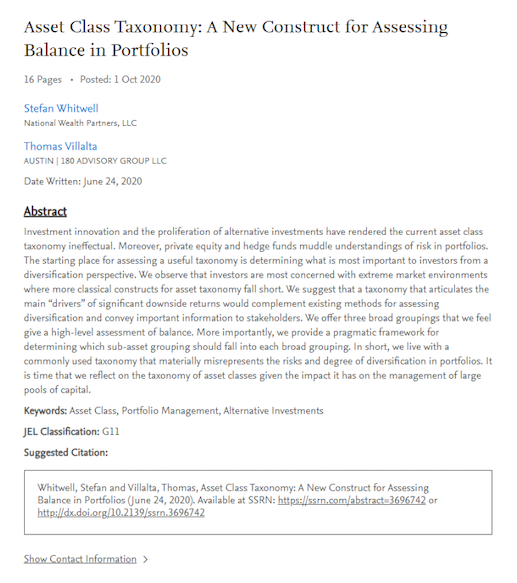
In proposing a new taxonomy to address asset diversification, Tom and co-author Stefan Whitwell, propose a new construct for both viewing broad portfolio risk and the interplay between various types of investments. In the end, this illuminating piece is meant to be both thought-provoking and action oriented. Assessing risk and managing risk are as much an art as they are a science, as this paper reveals. Asset Class Taxonomy: A New Construct for Assessing Balance in Portfolios is currently soliciting peer feedback on SSRN (the Social Science Research Network).
Abstract
Investment innovation and the proliferation of alternative investments have rendered the current asset class taxonomy ineffectual. Moreover, private equity and hedge funds muddle understandings of risk in portfolios. The starting place for assessing a useful taxonomy is determining what is most important to investors from a diversification perspective. We observe that investors are most concerned with extreme market environments where more classical constructs for asset taxonomy fall short. We suggest that a taxonomy that articulates the main “drivers” of significant downside returns would complement existing methods for assessing diversification and convey important information to stakeholders. We offer three broad groupings that we feel give a high-level assessment of balance. More importantly, we provide a pragmatic framework for determining which sub-asset grouping should fall into each broad grouping. In short, we live with a commonly used taxonomy that materially misrepresents the risks and degree of diversification in portfolios. It is time that we reflect on the taxonomy of asset classes given the impact it has on the management of large pools of capital.
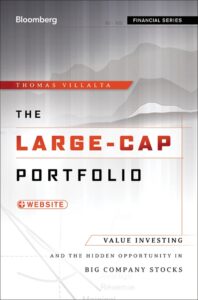
Tom’s knowledge of behavioral inefficiencies in the U.S. stock market and unique investing strategies led Villalta to write, “The Large-Cap Portfolio: Value Investing and the Hidden Opportunity in Big Company Stocks,” in 2012. Published by John Wiley & Sons’ Bloomberg Press imprint and labeled “Contrarian and revolutionary…” Villalta’s book shows investors how there’s money to be made seeking out the large-cap stocks most investors ignore.
REVIEWS:
“Tom Villalta has crafted a thoughtful must-read for anyone who’s a stock picker, anyone looking to step up their game in investing returns, or even the casual reader interested in how markets work. The book not only offers insightful tips from a seasoned pro, but also a spirited defense of the passion for picking stocks in an age when many are content to let the machines take over investing.”
TIERNAN RAY, Senior Editor, Barron’s magazine
“Most investors hold large-cap stocks in their portfolios but don’t really understand why. In The Large-Cap Portfolio, fund manager Thomas Villalta offers a clear explanation as to the importance of owning large-caps and why this asset class should not be taken for granted. He also offers a compelling case for actively managed strategies as opposed to indexes or ‘closet-indexes.’ All in all, it’s an interesting, detailed look at an often overlooked sector of the market.”
GREGG GREEENBERG, Mutual Funds Reporter, TheStreet.com